Spacers and Minimum Focus Distance
TL;DR
Skip to the bottom if you just want to use the interactive magnification and minimum focus distance calculator.
The Need to Get Closer
I have a still life project that requires the camera to be close enough to the scene that it is at macro (1 : 1) or near macro scale. I do have a macro lens that I could use for this, but I need the scenes to be wider than the macro lens can capture. This would require some kind of panning solution to get the entire scene I have in mind stitched into a single image. Because the lens is not designed for panning, I’d have to accept lens edge artifacts if I manually slid the entire camera body & lens on a planar rail. This could work, but it’s not ideal, as there will be warping that needs to be adjusted for and the math to do that loses resolution. I am trying to capture very fine details across a wide area, so warping and stitching is an inferior solution.
Because I have an Alpa 12 Pano system that does most of what I need here, I started experimenting on what I could do to use this camera instead of my Phase One XF with the paired macro lens. This is where minimum focus distance comes into play. Lenses are designed to be able to focus from a near plane to infinity. This near plane is the minimum focus distance (MFD) of the lens. Any closer and the subject is blurry because the lens can’t focus that close. If you use spacers between the lens and the sensor plane, you change both the far and near focus planes. As you add spacers, the far and near focus planes move closer to the camera. Ok, so I know I can add spacers to get closer to the subject and use the giant image circle to create planar panoramic images without moving the lens, but which size spacer do I need? Can I stack multiple to get even closer? Scouring the internet for answers mostly arrived at put the spacer on and measure where the minimum focus plane becomes blurry. Guess and check is fine if you already own the spacers, but is not acceptable as each spacer increases in cost. Rolling the dice on expenditures seems like a bad idea to me. Surely, there’s some math that can give me an answer.
The Thin Lens and Lens Magnification Equations
Turns out the math to correctly solve this requires intimate knowledge of the lens’ design. You need to account for every element, thickness of the element, etc. I don’t need nanometer level precision to figure out if the spacer will work for my photo concept. Millimeters are a “good enough” approximation for me make a decision. Fortunately, the thin lens equation gives me that approximation of how extension tube size reduces MFD and adds magnification. It won’t be 100% correct but will let me understand the effective MFD differences between a 17 mm, 34 mm, and a 51 mm spacer.
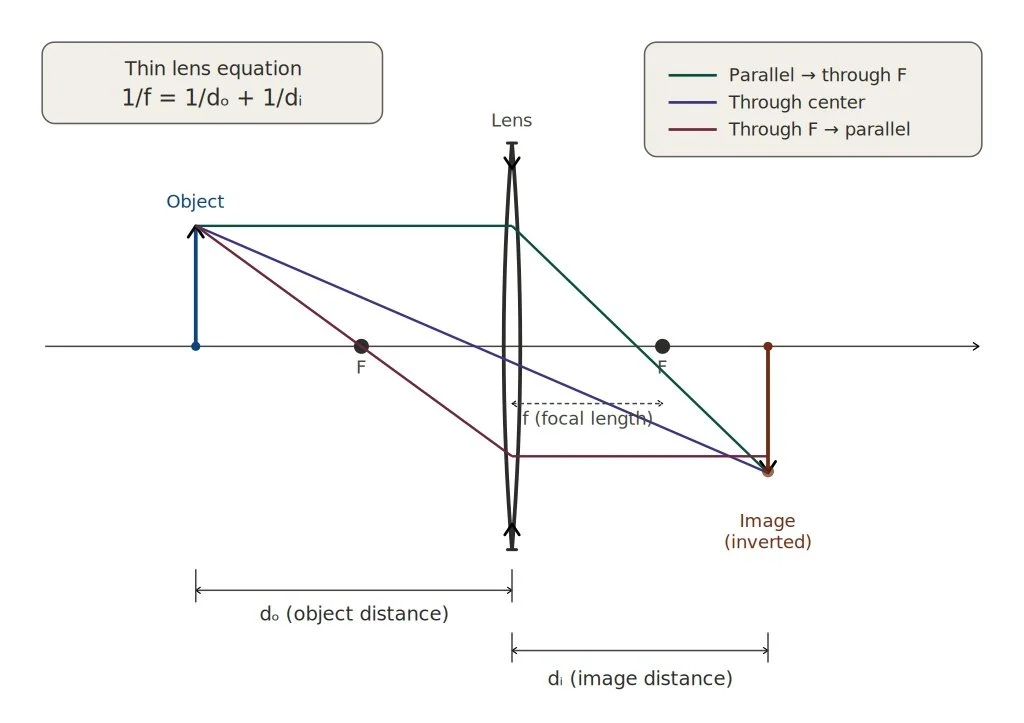
A visual diagram of the thin lens equation
Before we can solve this equation for a given lens, we need to be able to calculate the magnification factor for the lens including the spacer. This requires two pieces of data: the original magnification factor from the lens’ technical data sheet and the size of the spacer in mm. With that data we can calculate the new magnification factor using the equation below.
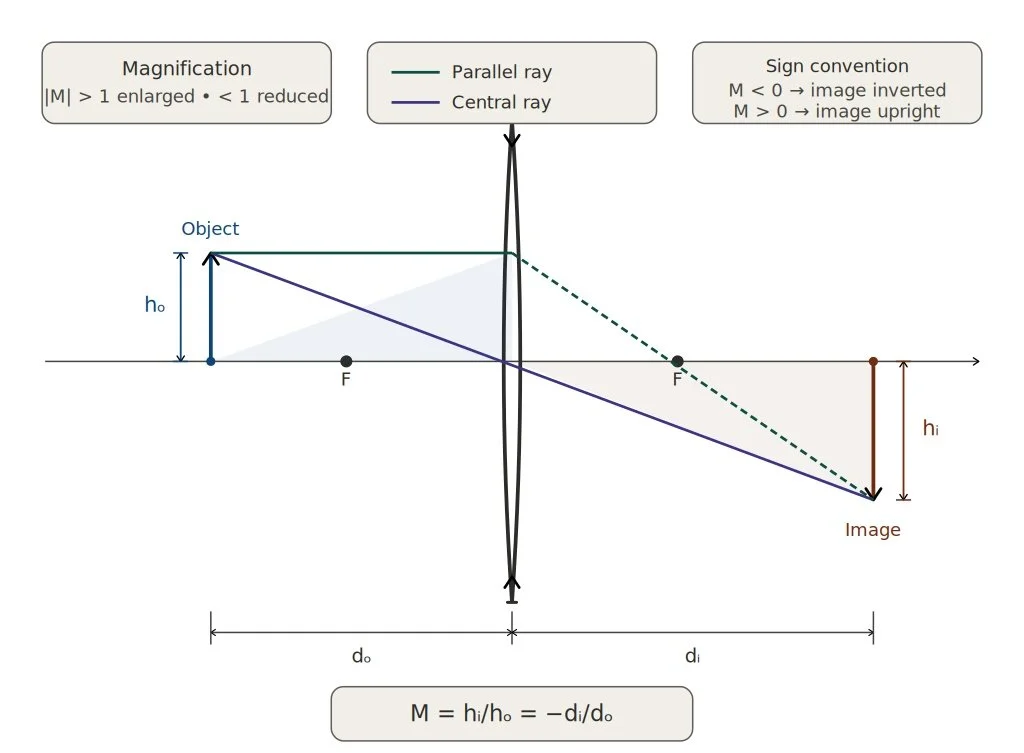
A visual diagram of the lens magnification equation
Notice that both equations use object and image distance within them. This means we can solve for those values and plug them into the thin lens equation to get a MFD solution. However, we new one more equation to be able to solve everything. We need to determine the new magnification of the lens when adding a spacer. This is pretty simple as seen below.
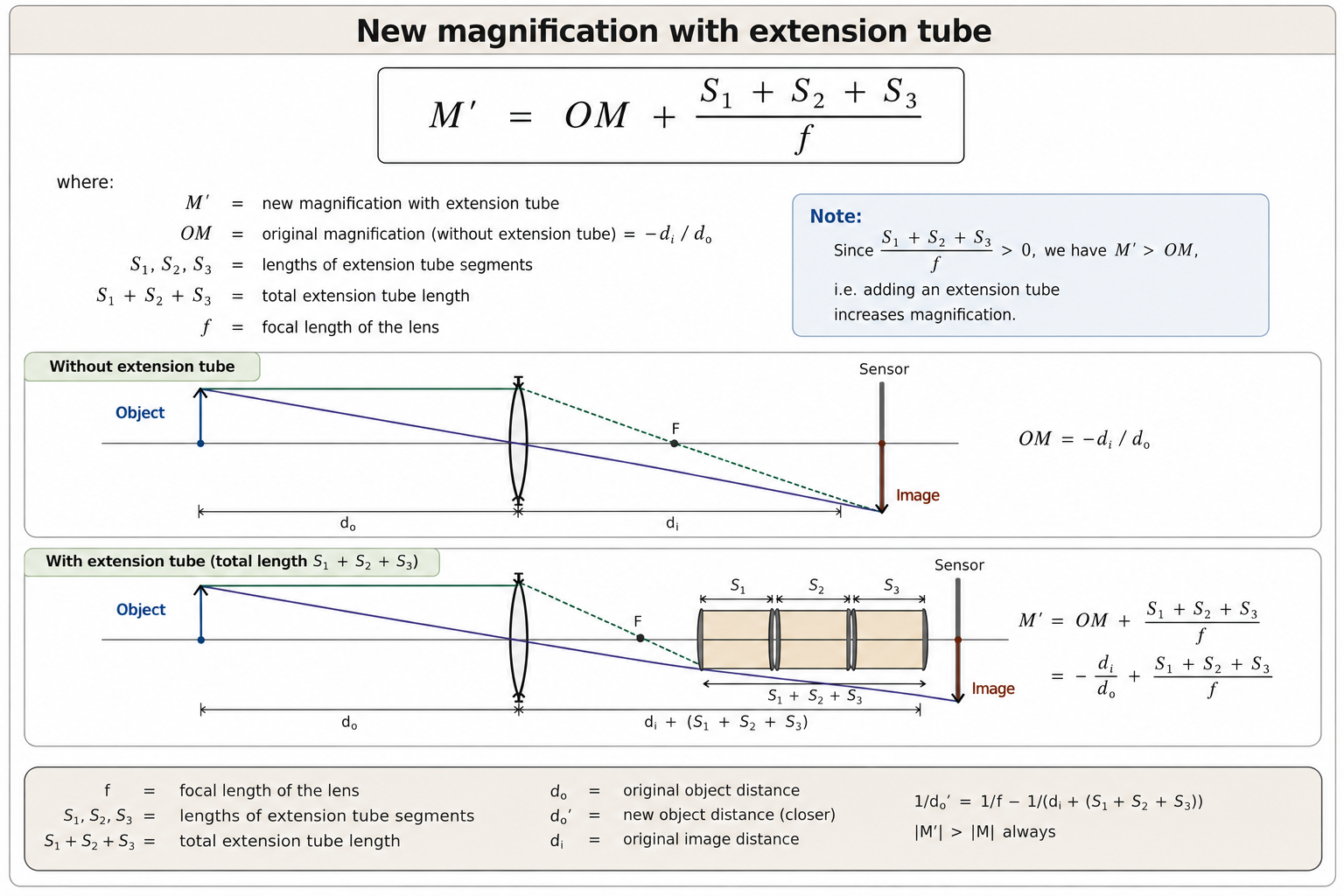
A visual diagram of how spacers affect magnification
The TL;DR here is that for every millimeter of extension tube length you get 1/focal length in increased magnification. A simple example is that if you have a 100 mm lens and add a 50 mm extension tube you have increased the magnification factor by 0.5. Macro lenses start at a 1 : 1 magnification factor so adding 0.5 gets you much closer to a macro lens while using a lens not designed for macro work.
Below is an interactive calculator that allows you to determine the new magnification and minimum focus distance for your lens when used with one or more spacers (extension tubes).
Spacer lengths (mm) — leave unused spacers at 0
M′ = OM + ((S₁ + S₂ + S₃) / f)
dₒ = f + (f / M′)
Object distance
— mm
dᵢ = M′ × dₒ
Image distance
— mm
MFD = dₒ + dᵢ
Min. focus distance
— mm
Some lens manufacturers don’t give you magnification but instead give you minimum focus distance. Use the calculator below to calculate the magnification.
f·M² − (MFD − 2f)·M + f = 0
M = [ (MFD − 2f) − √((MFD − 2f)² − 4f²) ] / 2f